Most businesses do not lose customers to one dramatic failure. They lose them quietly, to small problems nobody ever points out: a homepage that does not say what the business does, a call to action buried under three other buttons, a missing trust signal that makes a stranger hesitate. Nobody on your team notices these, because you already know what the business does. A stranger does not.
This is a practical method for finding those problems in about an hour, using an AI chat tool as a blunt, honest outside reviewer. It will not fix your website. It is very good at telling you exactly where to look.
This is a self-assessment method, not a professional audit. AI tools can misread a page or give a generic answer, so treat every finding as something to verify, not a fact. It works on marketing and sales pages; it is not a security or technical audit.
The short version
- Most lost customers are lost to confusion, not competition. A visitor who cannot tell what you do, what to do next, or why to trust you simply leaves.
- An AI model is a useful outside eye because it has no memory of your internal meetings and no loyalty to your brand. It only sees what is actually on the page.
- Five prompts, about an hour, free. Clarity, the one action, trust signals, friction and content gaps.
- AI finds problems. It does not fix them. Verify what it tells you, then prioritise and fix the real ones, ideally with a developer who can also address speed, forms and security.
Why this works
A founder or marketing lead reads their own homepage differently from everyone else. You know the backstory, the meeting where you agreed on the wording, and what you meant by that vague sentence. A first-time visitor has none of that context. They decide whether to stay or leave in a few seconds, based only on what is actually on the screen.
An AI chat tool is a decent stand-in for that stranger. Fed only the text or a screenshot of a page, with no other context, it will describe what the page actually communicates, not what you intended it to communicate. That gap between intention and reality is exactly where customers quietly disappear.
How to run the audit
- Open any AI chat tool you have access to.
- Open a fresh conversation, so there is no earlier context about your business.
- Copy the visible text of your homepage (or a key landing page), or take a screenshot of it.
- Paste it in and ask the five questions below, one at a time, reading the answer before moving to the next.
- Write down anything that surprises you. The useful findings are usually the ones you did not expect.
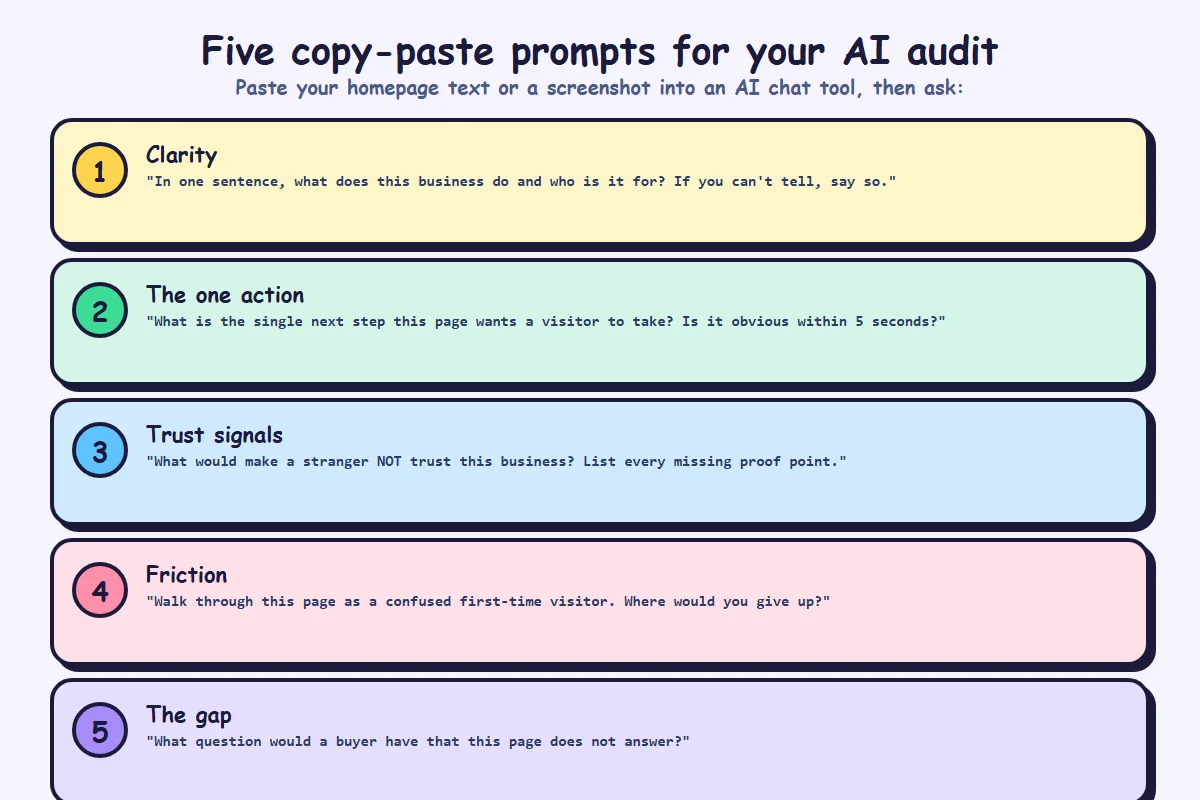
Prompt 1: Clarity
"Here is the text from my homepage. In one sentence, what does this business do and who is it for? If you cannot tell, say so plainly."
If the model struggles, hedges, or guesses wrong, a real visitor will too.
Prompt 2: The one action
"What is the single next step this page wants a visitor to take? Is it obvious within about 5 seconds of landing on the page?"
A page with five competing buttons usually gets none of them clicked.
Prompt 3: Trust signals
"Imagine you are a cautious stranger who has never heard of this business. What would make you NOT trust it? List every missing proof point: reviews, credentials, security signals, contact details, anything."
This question tends to surface the most useful, specific answers.
Prompt 4: Friction
"Walk through this page step by step as a confused first-time visitor trying to decide whether to buy or enquire. At which point would you most likely give up?"
Prompt 5: The gap
"What is one question a serious buyer would have after reading this page, that the page does not answer?"
What people usually find
In our own experience reviewing client sites, the same handful of problems come up again and again, and this method tends to surface the same kind:
- A headline that describes the company ("Founded in 2019...") instead of the customer's problem.
- A call to action that competes with two or three others for attention.
- No visible phone number, address or response time, which quietly raises doubt.
- Jargon that makes perfect sense internally and means nothing to a new visitor.
- A page that explains the product but never says what it costs, or how to get started.
Your results will be specific to your own page. Do not assume these apply to you; that is exactly what the audit is for.
Turning findings into fixes
Not every answer the AI gives is worth acting on. Treat the output as a list of hypotheses, then sort it.
| Signal | What to do |
|---|---|
| The model misunderstood something true and clear | Ignore it; the model made a mistake |
| The model found something genuinely confusing or missing | Fix the wording or add the missing proof point, often cheap and fast |
| The model flagged a structural problem (navigation, forms, speed, layout) | This usually needs a developer, not just a copy edit |
| The model's answer was vague or generic | Ask it to be specific, or discount that answer |
A quick rule: if two of the five prompts point at the same weak spot, from different angles, that is worth fixing first.
The limits, honestly
- AI tools can be wrong or generic. Always check a finding against your own judgement, and ideally ask a colleague who knows the business but not the website.
- It only reviews what you give it. It cannot see your actual page speed, whether your forms work, or whether your site is secure. For those, you need real tools and a developer's review.
- It does not know your market. It cannot tell you if your price is right or your offer is strong, only whether the page communicates clearly.
- Treat results as a starting list, not a scorecard. The value is in the specific, surprising findings, not a score out of ten.
A simple checklist
- Run the five prompts on your homepage and your most important landing page.
- Write down every finding that surprises you.
- Sort findings into "quick wording fix", "needs a developer" and "ignore".
- Fix the wording issues this week.
- Get a developer's view on anything structural: speed, forms, mobile layout, security.
- Re-run the audit after the fixes, in a fresh conversation, and compare the answers.
How SimpleApp can help
Once you know what is costing you customers, SimpleApp is here to help you grow your business online. We fix what an audit like this uncovers and build what comes next: faster, clearer websites, SEO that brings the right visitors, and custom software or AI features when your business needs more than a content fix. See our SEO services, web application development and AI-powered applications, or get in touch for a free, no-obligation quote.