This is a warning, and it is worth reading to the end. For years, "AI will be used for fraud" was a sentence about the future. In 2026 it became a sentence about now. The tools to fake a voice, a face or a whole identity are cheap, fast and good enough to fool careful people. This post lays out what the data actually shows, who is at risk, and the simple steps that still stop these attacks today.
Last updated: 31 October 2026. The figures below come from vendor and industry reports and news coverage, not from a single official source, and counts differ between reports. Please check the linked sources, and treat anything about law or insurance as a question for a qualified adviser, not as advice.
The short version
- AI is now in most fraud. An October 2026 report found more than half of distinct fraud schemes used AI-generated or AI-assisted material.
- Cloned voices and faces are mainstream. Fraudsters recreate a boss, a supplier or a family member convincingly, often in real time.
- "Deepfake job candidates" are a named 2026 threat. AI can build fake candidates who pass live interviews, putting strangers inside your systems.
- The attack is almost always the same shape: fake someone you trust, create urgency, and push you to skip the normal checks.
- The defence is still simple and human. Verify on a known channel, use a code word, require two approvals, and slow down.
What the numbers say
Let us be careful and specific, because fear without facts helps no one.
- More than half of fraud now uses AI. According to a State of Ad Fraud 2026 report by ADEX, reported by CybersecurityNews on 29 October 2026, 52% of distinct fraud schemes showed AI-generated or AI-assisted assets, based on data from January to September 2026. Of the schemes that involved AI, 11% used deepfakes specifically. So AI is now common in fraud, and deepfakes are a growing part of it.
- The experts expect more. Experian's Future of Fraud Forecast, released on 13 January 2026, names five top threats for the year: agentic AI running machine-to-machine fraud, "deepfake job candidates" who pass real-time interviews, smart-home attacks, AI website cloning, and emotionally intelligent scam bots that run romance and "relative in need" scams without a human.
- The losses are large. Experian cites the US Federal Trade Commission's figure that consumers lost more than 12.5 billion dollars to fraud in 2024, and its own data that nearly 60% of companies reported higher fraud losses from 2024 to 2025.
- Ordinary people are being reached. Reporting on scam trends this year describes AI deepfake voice calls reaching a large share of the public, and consumer bodies warning that older ways of spotting a fake no longer work. Figures vary by source, so treat the exact numbers as estimates and the direction as clear.
The honest summary: this is not hype any more. It is a measured, rising risk that now touches normal businesses and families, not just large banks.
How an AI fraud attack actually works
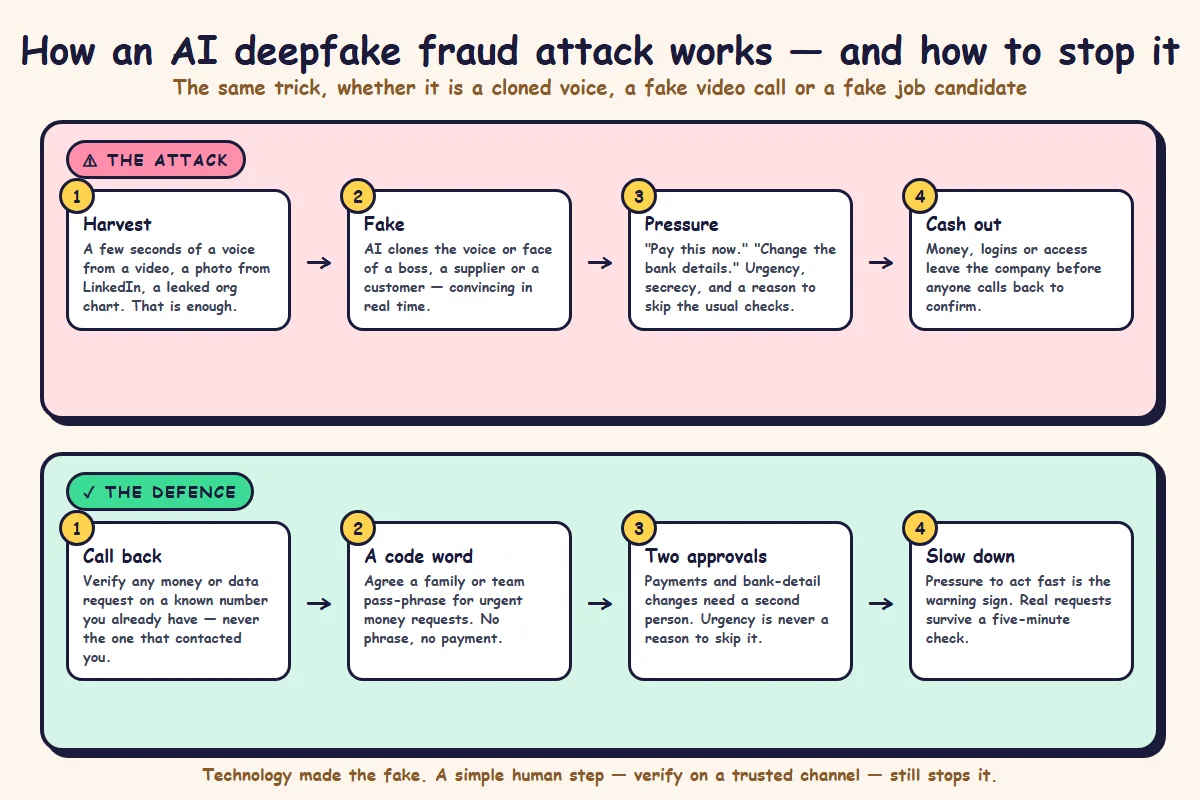
Almost every one of these attacks follows the same four steps:
- Harvest. The attacker collects raw material: a few seconds of a voice from a video or voicemail, a photo from a public profile, a company's org chart, an invoice template. It does not take much.
- Fake. AI clones the voice or face of someone you trust, a manager, a supplier, a customer or a relative, often convincingly enough to work on a live call.
- Pressure. The fake asks for money, a change of bank details, a password or access, and adds urgency and secrecy: "Do this now, do not tell anyone, I am about to go into a meeting."
- Cash out. The money, the login or the access leaves before anyone independently calls back to confirm.
The whole scam depends on one thing: getting you to skip the normal check. That is also where it can be stopped.
The defence is still simple, and still human
The powerful part of this warning is also the hopeful part. The technology that makes the fake is advanced. The step that defeats it is not.
- Call back on a number you already trust. If "your bank", "your boss" or "your supplier" asks for money or data, verify it using a phone number or contact you already have, never the number or link that contacted you.
- Agree a code word. For families and for finance teams, agree a simple pass-phrase for any urgent money request. No phrase, no payment. A cloned voice will not know it.
- Require two approvals. Payments above a set amount, and any change to bank details, should need a second person. Urgency is never a reason to skip this.
- Slow down on purpose. Pressure to act immediately is the single most reliable warning sign. A real request survives a five-minute check. A scam usually does not.
None of these needs new technology. They need a rule everyone follows, even when the voice on the phone sounds exactly like someone you know.
What it means for your company
- Write down a verification rule and share it. Everyone who can move money or change records should know the call-back and two-approval rules by heart.
- Protect the money-movement steps in software. Approvals, limits and an activity log for payments and bank-detail changes make the scam far harder. Our briefing on audit-ready business software covers how to build these controls in.
- Guard your hiring. "Deepfake job candidates" are a named 2026 threat. For remote roles, verify identity carefully before granting access to systems, and limit what a new joiner can reach on day one.
- Reduce the raw material. The less of your executives' voices, org charts and internal detail that sits in public, the harder the first step becomes.
- Train little and often. A short, regular reminder with a real example does more than one long annual session.
- Have a plan for when it happens. Know who to call at your bank, who to tell internally, and how to act fast, because speed matters once money has moved.
A checklist to share with your team today
- Do we verify every money or data request on a known, separate channel?
- Do we have a code word for urgent money requests?
- Do payments and bank-detail changes need two people?
- Does everyone know that urgency and secrecy are warning signs, not reasons to hurry?
- Do our payment systems keep an activity log we can actually review?
- Do we verify the identity of remote hires before giving them access?
- Do we know exactly who to call if money has already left?
How SimpleApp can help
We build custom software with approvals, limits, verification steps and clear activity logs designed in from the start, so the riskiest actions in your business are not one phone call away. See our custom software development, business automation and AI-powered applications services, or get in touch and tell us what you need to protect.