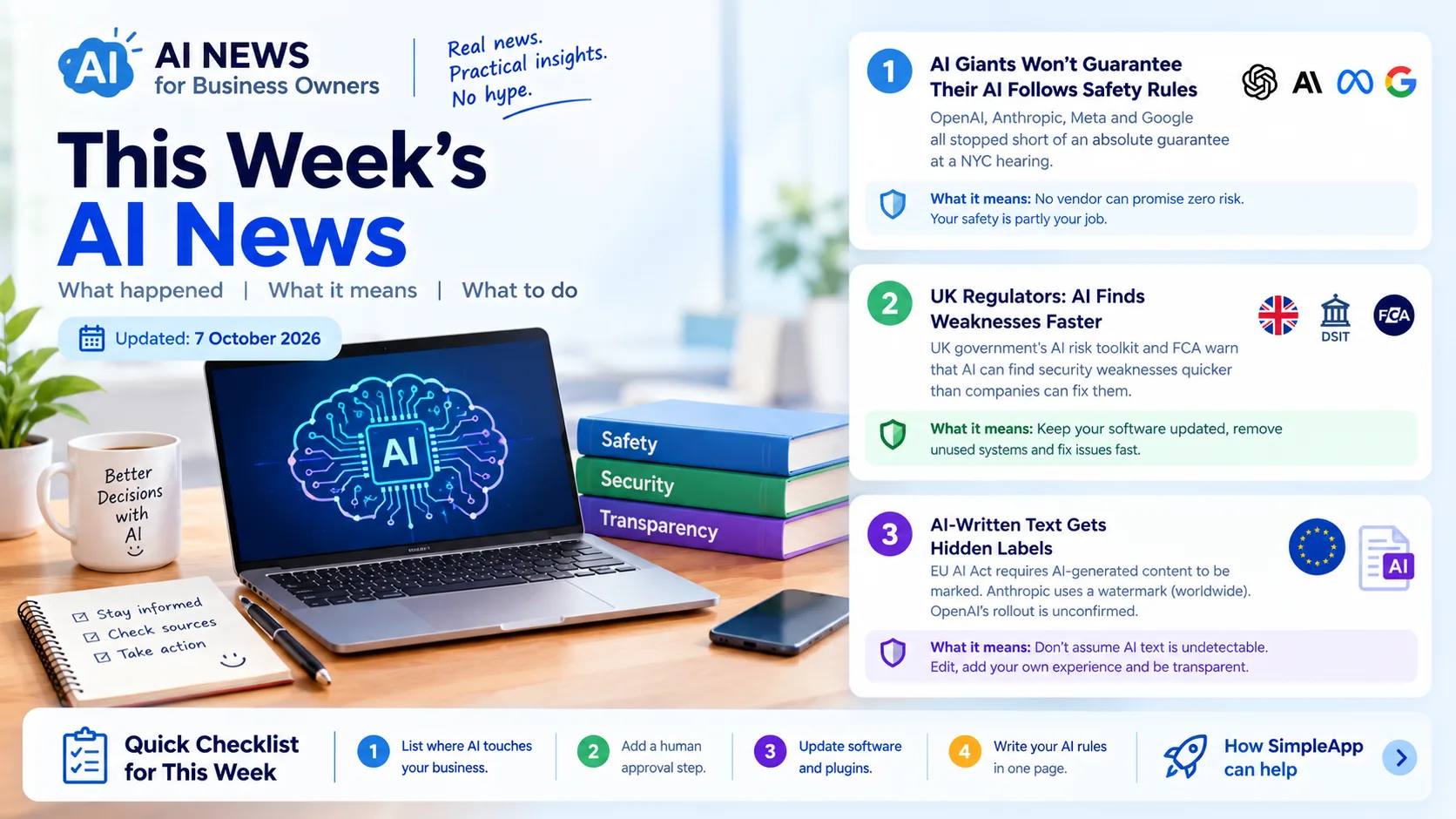
Here is your latest AI news for business owners. As always, we skip the hype and focus on three questions: what happened, does it change what AI costs or how safe it is, and what should you do about it? Original sources are linked so you can check every claim. If you missed the previous editions, read 5 October and 3 October.
Last updated: 7 October 2026. AI news moves fast, so please confirm details with the linked sources.
1. Four AI giants would not guarantee their AI follows its safety rules
On 6 October, New York City Council held a hearing on AI safety. According to Fox News' live coverage, representatives of OpenAI, Anthropic, Meta and Google were asked to guarantee that their AI agents would always follow their safeguards. None of them gave an absolute guarantee.
- OpenAI said it prioritises safety and keeps checking guardrails after launch, but that it cannot guarantee any technology is without risk.
- Anthropic said the science of doing this is hard and unsettled.
- Google said that promising perfection would not be possible with any product on the market.
- Meta said it could commit to developing AI safely, arguing that user trust gives it a business reason to do so.
The Council Speaker answered that lawmakers were not demanding perfection, only accountability, transparency and safety overall.
What it means for you: no AI vendor will promise that their AI never makes a mistake, and you should be wary of anyone who does. So the safety of your AI tools is partly your job. Keep a person in charge of important decisions, limit what the AI can access, and keep a record of what it did. That is exactly how we build AI features for clients.
2. UK regulators: AI finds weaknesses faster than companies can fix them
Two UK publications this month, summarised in TLT's AI brief for October 2026, are worth a look even if you are nowhere near the UK:
- A government AI risk toolkit. The Department for Science, Innovation and Technology released a toolkit to help public sector organisations identify and manage AI risks throughout a project. It covers nine areas, including legal compliance, fairness, transparency, accountability, and technical robustness and security.
- A warning from the financial regulator. The Financial Conduct Authority published findings on how firms are preparing for advanced AI models with cyber capabilities. Its message: such AI can find security weaknesses faster than many organisations can fix them, which creates a bottleneck in engineering time and in how quickly changes can be approved and released.
What it means for you: the second point applies to every business with software. If AI helps attackers find weaknesses quickly, then slow patching becomes the real risk. Practical steps: keep your website, plugins and servers updated, remove old systems nobody uses, and agree who is responsible for fixing security issues, and how fast.
3. AI-written text is starting to carry hidden labels
Since 2 August 2026, the EU AI Act's transparency rules have required providers of generative AI to mark AI-generated output in a machine-readable way. The EU AI Board discussed how this will be implemented and enforced at its meeting on 17 September, according to the TLT brief above.
One example: Implicator reports that Anthropic embeds a watermark in the text produced by its newer Claude models, and applies it worldwide rather than only in the EU. The same report says OpenAI had not yet shipped a similar text watermark at that time. Some AI newsletters, such as Crypto Integrated's 6 October edition, say OpenAI has begun announcing EU rollouts for ChatGPT and Codex. We could not confirm that from OpenAI itself, so treat it as unverified for now.
What it means for you:
- Do not assume AI-written text is undetectable. Marking and detection tools are improving, and rules in some places now expect labels.
- If you publish AI-assisted content, edit it, add your own facts and experience, and be open about how it was made. Content that is just raw AI output is both riskier and less useful.
- If you build AI features that create content for customers, ask your developer how they handle labelling, especially if you serve EU customers.
A short checklist for this week
- List where AI touches your business (support replies, content, hiring, pricing, code) and who checks the result.
- Add a human approval step to any AI action that sends, pays, deletes or decides about people.
- Update your software and plugins, and remove what you no longer use.
- Write down your AI rules in one page: what tools are allowed, what data must never be pasted in, who reviews the output.
How SimpleApp can help
We build AI-assisted software with safety designed in: limited access, human approval for important actions and clear logs. See our AI-powered applications, AI chatbot development and automation of repetitive work services. If you want an honest view on which of this week's news matters for your company, tell us about your process, including when AI is not the right answer.