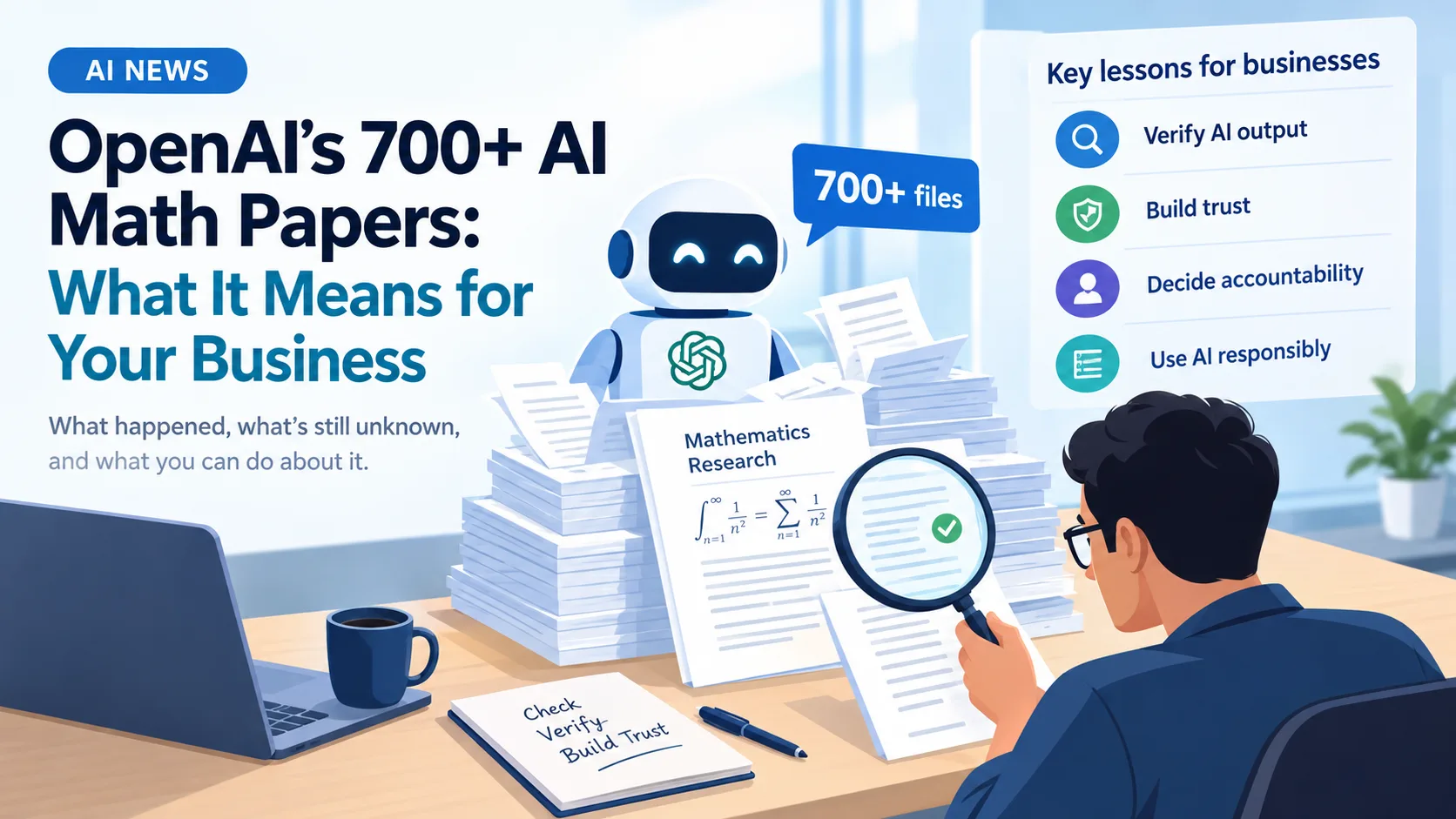
This is one of the most debated AI news stories of the week, and it carries a lesson for any business that uses AI to produce work at scale. Below we explain what happened, what is still unknown and what you can do about it. We link the original sources so you can read them yourself, and we do not take a side.
Last updated: 9 October 2026. The story is still developing, so please check the linked sources for the latest details.
The short version
- On 6 October, OpenAI published a large batch of AI-generated mathematics manuscripts.
- The Association for Human Mathematics (AHM) responded the next day, saying mathematicians did not ask for this and urging people to stop working with OpenAI.
- Nobody has yet established whether all of the claimed results are correct.
- For business owners, the real lesson is about checking AI output, earning trust and deciding who is accountable.
What happened
The AHM's statement, which Terence Tao shared as a guest post on his blog on 7 October, says OpenAI released "over 700 files" at once. Reports differ on the exact numbers. OpenAI separately said that one AI agent, given a single prompt, produced 372 new mathematical results, according to Scientific American as summarised by AI Weekly. Counts also vary between outlets, because the files and the "results" in them are not the same thing.
What the mathematicians are saying
According to the AHM statement and coverage by The Decoder, the group argues that:
- Mathematicians did not ask for this work to be done.
- OpenAI ignored the advice of an outside advisory group on mathematics and AI, which said that frontier AI companies should not test advanced problems on their internal models.
- The release shows disregard for research norms that protect trust.
- The release was, in the statement's words, "a demonstration of power" rather than scholarship.
It urges mathematicians to stop working with OpenAI and asks the public to treat this way of publishing with "due skepticism". The Decoder also reports that Tao has argued that solving problems at industrial scale can change a field in ways that cannot be undone, and that human understanding should come first. Commenters on the statement disagreed sharply with each other.
What is still unknown
- Are the results correct? The Decoder reports no formal errors found so far, but also that correctness has not been established. One mathematician quoted there called a headline paper very hard to read. Checking hundreds of long proofs takes experts a long time.
- How many results are there? Sources give different counts, as noted above.
- What does OpenAI say? The Decoder's report did not include a direct OpenAI response to the boycott call.
We have left out claims that appeared on only one low-reliability website, such as specific figures for how many papers passed automated checks.
Why this matters to a business, not just mathematicians
You may not publish maths papers. But many companies now use AI to produce reports, proposals, product descriptions, code, support replies and marketing at high volume. The same questions apply.
1. Volume is not verification
If AI writes 700 things in an afternoon, a person must still check them. The cost of review now matters more than the cost of generation. Before you scale AI output, ask how many outputs your team can really verify.
2. How you release AI work affects trust
The argument here is partly about the work and partly about how and why it was released. If customers, partners or staff feel that AI output was dumped on them without their consent, you can lose trust even if the output is good. Tell people when AI was used, and where a human has reviewed it.
3. Your reviewers are the bottleneck
Experts who can judge the work are scarce and slow. When you plan an AI project, budget for qualified reviewers, not only for tools.
4. Decide who is accountable before you publish
Write down who signs off on AI output before it reaches customers. A named person, a simple checklist and a record of what was checked turn "the AI said so" into something you can stand behind.
A short checklist for this week
- List what your team produces with AI (reports, copy, code, replies).
- Name an owner who approves each type before it goes out.
- Sample and check a fixed share of output, and track the error rate.
- Add a disclosure line where AI helped, if your customers would want to know.
- Keep a record of prompts, versions and who approved them.
How SimpleApp can help
We build AI-assisted software with checking and accountability designed in: human approval steps, clear logs and limits on what the AI can do. See our AI-powered applications and business automation services, or tell us about your process and we will give you an honest view, including when AI is not the right answer. You can also read our earlier AI news roundups.