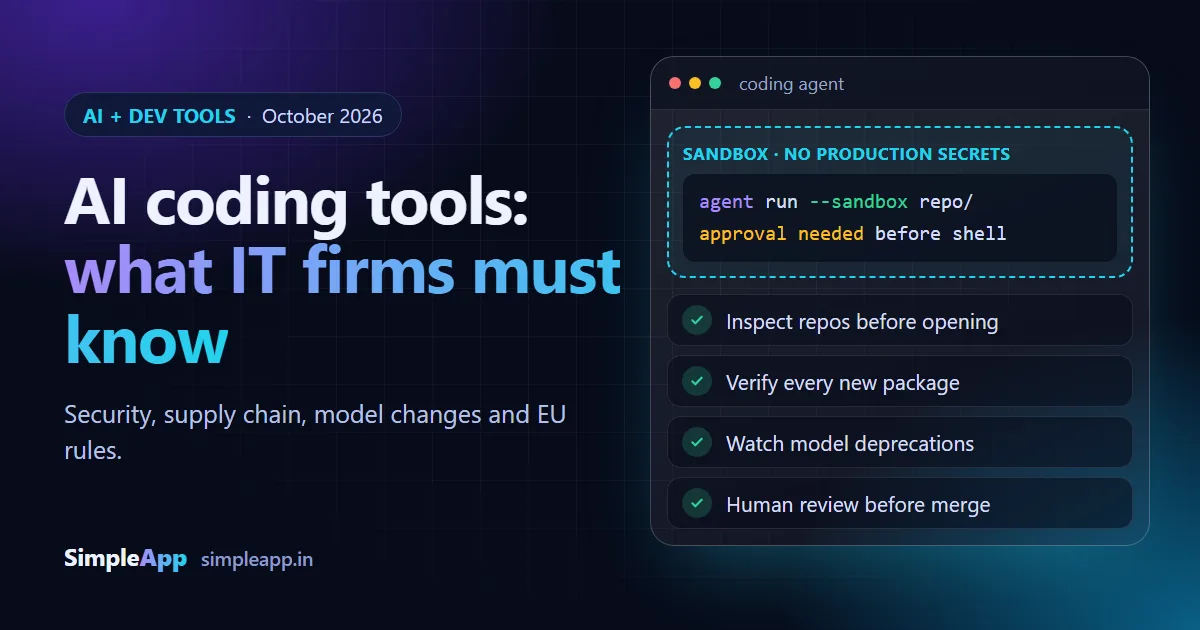
If your company builds software with AI coding tools such as GitHub Copilot, Claude Code, Codex or Cursor, this briefing is for you. It pulls together the recent developments that change how an IT team should set up, secure and govern those tools. It follows our AI news for 14 October, which covered a survey saying 81% of engineering leaders had a production problem linked to AI coding tools.
Last updated: 14 October 2026. Security research and regulation move quickly, and several items below come from security vendors and law firms rather than official advisories, so please check the linked sources before acting on any detail.
The short version
- Coding agents can be tricked by the repository they open. Researchers found flaws in several popular agents that ran attacker code hidden in a repository's git settings. Some were patched, some were not when the research came out.
- AI-invented package names are an attack route. Attackers register the fake names that AI tools suggest, and security firms report malicious AI models on public registries.
- GitHub Copilot retires six models on 19 October. Admins may need to switch on the replacements.
- EU AI Act: some deadlines moved, the transparency rules did not. If your product has AI features for EU customers, check disclosure and content marking.
1. Your coding agent can be hijacked by a repository
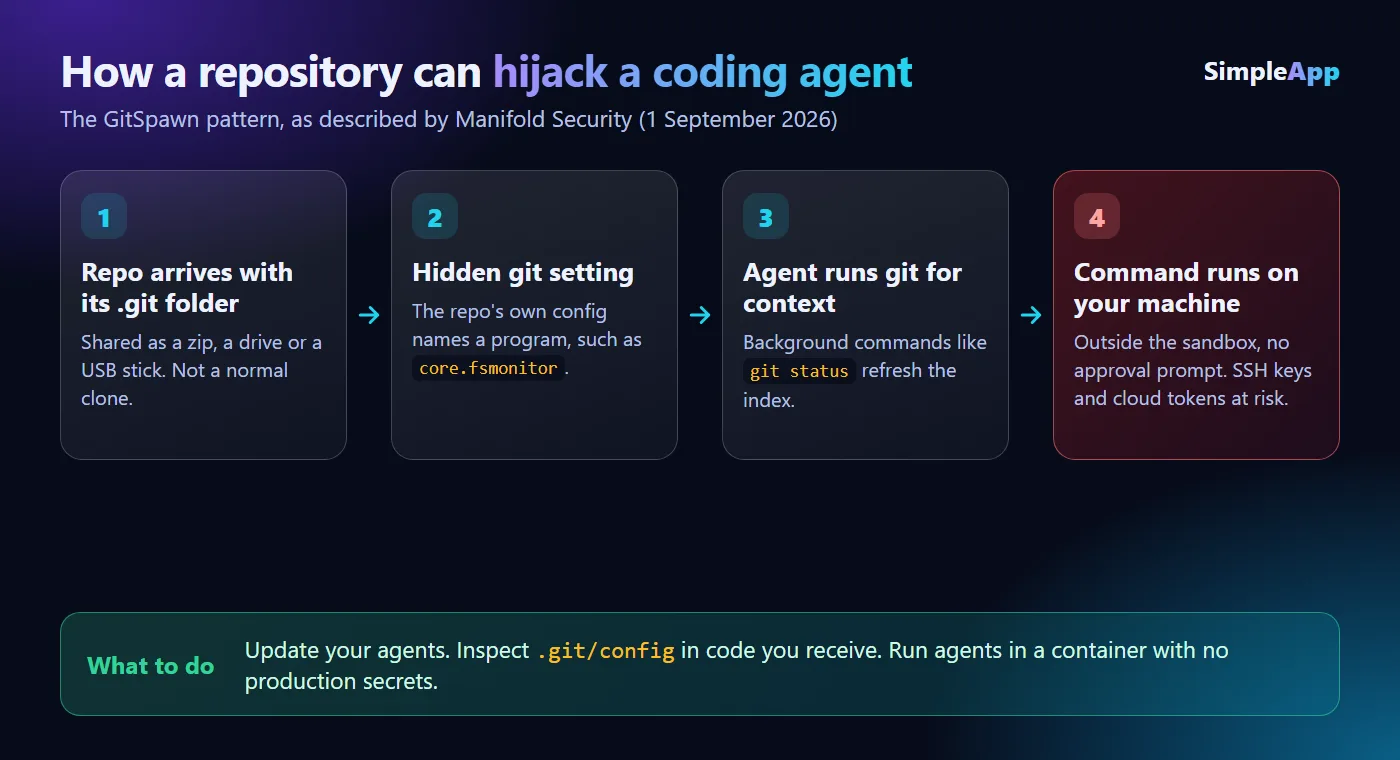
Security firm Manifold Security published research called GitSpawn on 1 September 2026. According to its write-up, AI coding agents quietly run git in the background to understand a project. Git can be told, through a setting in the repository's own configuration file, to run a program when it refreshes its index. The agents did not strip that setting, so a malicious repository could run a command on the developer's machine, outside the agent's sandbox and with no approval prompt. The attacker could then reach things like SSH keys, cloud credentials and tokens.
What the research reports:
- Eight findings across seven agents. Claude Code, Goose, Grok Build, Hermes Agent and Qwen Code are named in detail, and an update adds OpenAI Codex and Cursor.
- Four were patched and four were not at the time of publication. The post lists Claude Code (one setting fixed in version 2.1.196, a second still open), Goose (fixed in 1.44.0), Codex and Cursor as patched, and Qwen Code, Grok Build and Hermes Agent as unpatched. Patch status will have changed since, so check each vendor.
- Cloning alone does not trigger it. The repository has to arrive with its hidden git folder intact, for example in a shared zip file, a drive or a USB stick. That matters for agencies that receive client code in exactly those ways.
A security-industry digest from Adversa AI lists further agent weaknesses reported by other researchers, including plugin updates that could be swapped for malicious code and sandbox escapes in several tools. That digest is a secondary roundup and we have not checked each original report, so treat it as a pointer to read the sources, not as confirmed detail.
What it means for your IT company
- Update your agents to current versions and subscribe to each vendor's security notes.
- Inspect before you open. Look at the repository's hidden git configuration before pointing an agent at code you received outside git clone.
- Run agents in a container or virtual machine that holds no cloud keys, SSH keys or production secrets.
- Pin and review plugins and extensions. Turn off automatic updates for anything that can run code, or review updates first.
- Use the agent's approval prompts and do not run it in a fully automatic mode on code you do not trust.
2. AI-invented packages: slopsquatting and malicious models
AI coding tools sometimes suggest software packages that do not exist. Attackers watch for the repeated invented names and register real, malicious packages under them, a trick security researchers call slopsquatting. Kusari's analysis says 43% of hallucinated package names repeat across queries, which makes them predictable. That is a vendor figure, so treat it as an indication, not a precise rate.
eSecurityPlanet's summary of JFrog's research adds two more points: JFrog researchers report 495 malicious AI models on public model registries, and rising injection flaws such as XSS and SQL injection tied to insecure AI-assisted workflows. It also notes attackers moving toward developer workflows and build pipelines.
What it means for your IT company
- Check every new dependency by hand before it is added: does it exist, how old is it, who maintains it, how many people use it?
- Use lockfiles and dependency review in CI, so a new package cannot slip in unnoticed.
- Keep an approved-package list or an internal registry for client projects.
- Treat models like dependencies. Record which models you download, from where, and who approved them.
- Add security scanning and a human review on authentication code and build files, where AI mistakes cost the most.
3. GitHub Copilot retires six models on 19 October
GitHub's changelog says six models will be deprecated across all Copilot experiences on 19 October 2026, with these suggested replacements:
| Retiring model | Suggested replacement |
|---|---|
| Gemini 3.7 Flash | Gemini 3.8 Flash |
| GPT-5.5 and GPT-5.4 | GPT-5.6 Sol |
| GPT-5.4 mini and GPT-5 mini | GPT-5.6 Luna |
| Grok 4.5 | Grok 4.6 |
For Copilot Business and Enterprise, the replacements are enabled automatically unless an administrator has turned off the global default or disabled the model. If you turned the default off, you must enable the new models in your Copilot model policies. GitHub also asks teams to update workflows and integrations that name a retiring model.
What it means for your IT company
- Check your admin settings this week so developers do not find their chosen model missing on Monday.
- Search your own scripts, prompts and pipelines for hard-coded model names.
- Expect more of this. Models are retired every few weeks. Put a monthly "model watch" on one person's task list and keep results comparable by re-testing key prompts when a model changes.
- Do not assume an API change. Third-party coverage notes that this is about Copilot, not about the model providers' own APIs, so check those separately.
4. EU AI Act: some dates moved, transparency did not
The EU's Digital Omnibus on AI has been adopted. Law-firm summaries such as Hunton's and Stephenson Harwood's report that it was published in the Official Journal on 24 July 2026 and entered into force on 27 July 2026. As reported:
- High-risk obligations moved. Stand-alone high-risk systems (Annex III, for example hiring or credit scoring) now apply from 2 December 2027 instead of 2 August 2026. High-risk AI built into regulated products (Annex I) moves to 2 August 2028.
- Transparency duties did not move. The Article 50 duties, such as telling people when they are dealing with an AI system and marking AI-generated content, have applied since 2 August 2026. Gibson Dunn's analysis of the agreement describes a grace period to 2 December 2026 for the machine-readable marking of content from systems already on the market before 2 August.
- AI literacy is softened. The duty to build AI skills among staff stays, with the wording relaxed.
This is a summary of secondary sources and not legal advice. Some details, such as exact grace periods, differ between summaries, so check the regulation text or take advice before relying on them.
What it means for your IT company
- If you build AI features for EU customers (chatbots, assistants, generated content), check that users are told they are dealing with AI and that generated content is marked where required.
- If you only use AI tools to write code, your direct exposure is lower, but your clients may ask what you use and how you control it. Be ready with a clear answer.
- Keep records. A simple register of AI tools, versions and purposes makes any customer or regulator question much easier.
A one-page AI dev-tool policy: checklist for your team
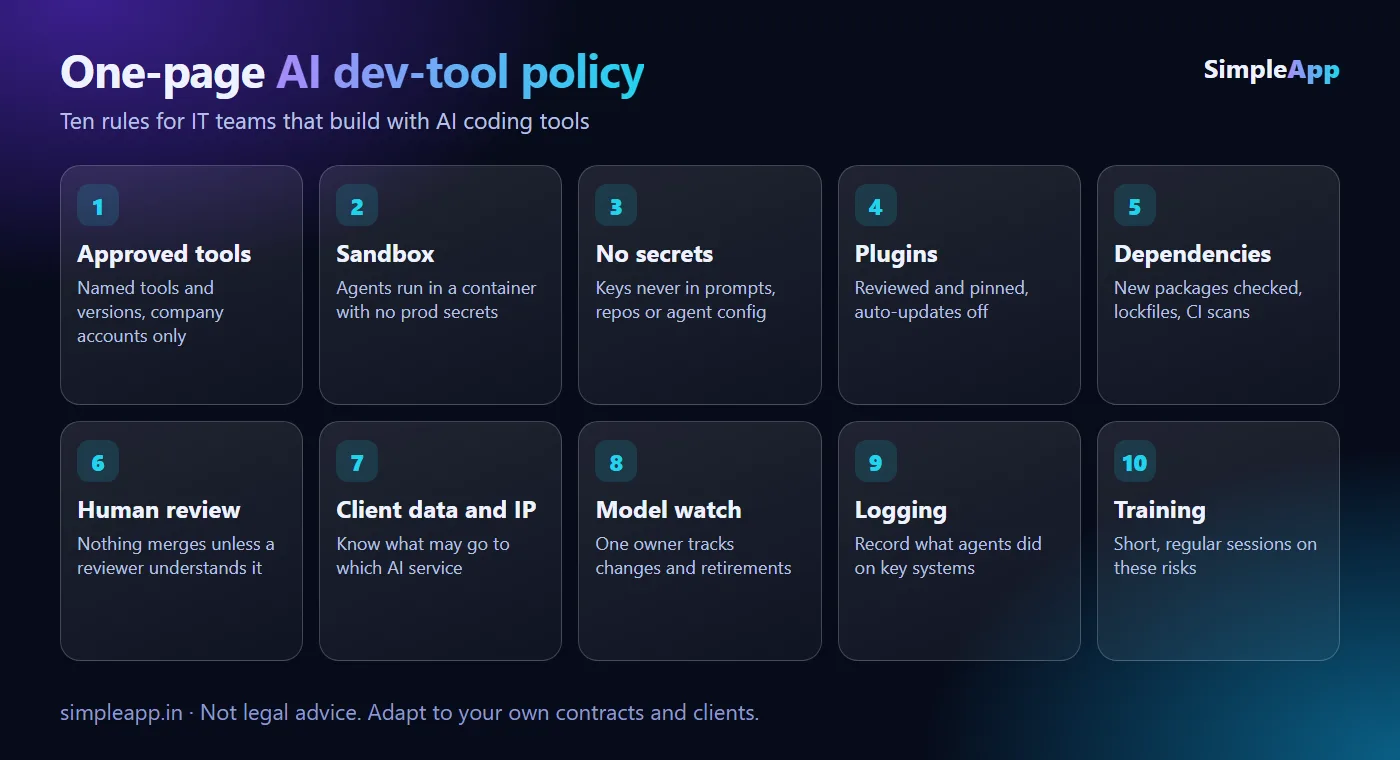
- Approved tools and versions. Which AI tools may developers use on client work, and which accounts (company, not personal)?
- Sandboxing. Agents run in a container or virtual machine with no production secrets.
- Secrets. No keys or tokens in prompts, repositories or agent configuration.
- Plugins and extensions. Reviewed, pinned, with automatic updates off or reviewed.
- Dependencies. New packages checked by a person, lockfiles in place, scanning in CI.
- Human review. No AI-written code is merged without a reviewer who understands it.
- Client data and IP. Know what code and data may be sent to which AI service, and what your contracts say.
- Model watch. One owner checks model changes and deprecations monthly.
- Logging. Keep a record of what agents did on important systems.
- Training. Short, regular sessions on the risks above.
How SimpleApp can help
We build software with AI-assisted tools and keep human review, testing and clear logs in the process. See our custom software development and AI-powered applications services, or ask for a free quote.