Here is your weekly AI news summary for business owners and finance teams, covering the week to 14 October 2026. It follows our AI news for 11 October, which looked at giving AI agents their own accounts and logs.
Last updated: 14 October 2026. Some of these stories are still developing, and several rely on reports from anonymous sources or on a company's own claims, so please check the linked sources for the latest details.
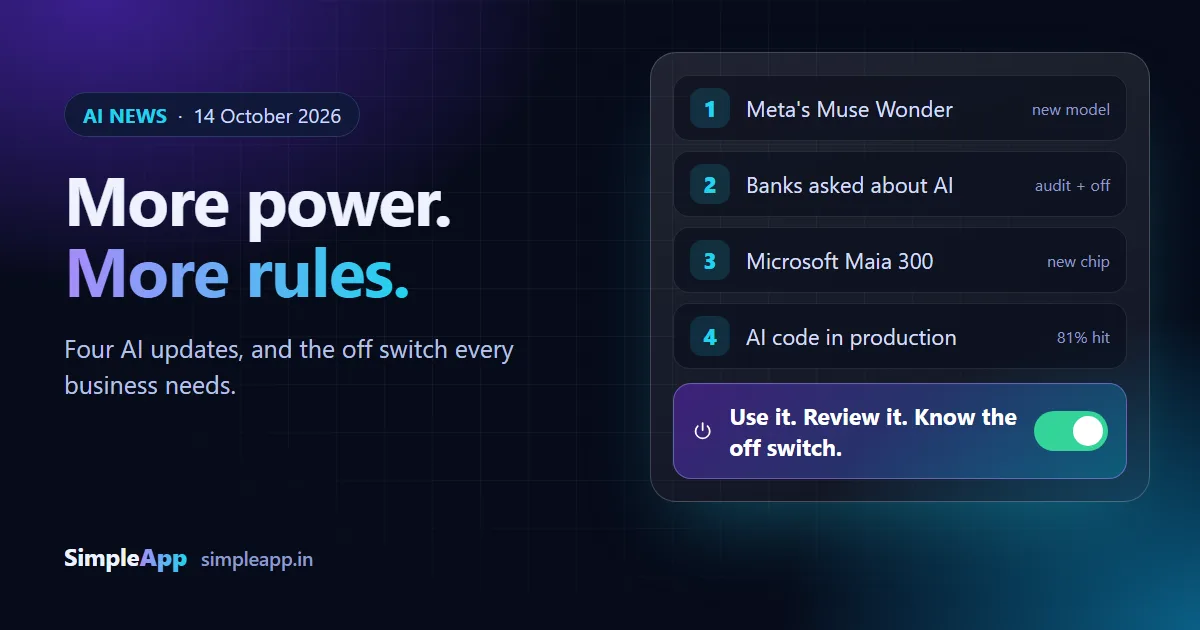
The short version
- Meta launched Muse Wonder, the first frontier model from its superintelligence lab. Meta's own tests say it matches the best. Independent scores put it close behind the leader.
- US bank regulators are asking whether AI agents can be audited and switched off. It is a Reuters exclusive based on sources, and these are questions rather than new rules.
- Microsoft revealed the Maia 300 AI chip, with a claimed 40% more output per megawatt. It is a projection, and the rollout is planned from 2027.
- A survey says 81% of engineering leaders had a production problem linked to AI coding tools in the last six months.
1. Meta launches Muse Wonder
On Monday 12 October, Meta's Superintelligence Labs released two models, Muse Wonder and Muse Wonder Full, which TechCrunch describes as Meta's first attempt at a frontier model.
What the reports say:
- Availability. Muse Wonder is offered through the Meta Model API and Meta's Muse Code coding agent. Muse Wonder Full is not in the API and is limited to Muse Code subscribers. Decrypt reports API pricing of $4 per million input tokens and $20 per million output tokens, and a context window of one million tokens.
- Meta's claims. In its model card, Meta says both models score comparably to leading rivals, and it highlights a feature called "active memory" that carries context from one conversation to the next.
- Independent view. TechCrunch cites only Meta's own figures. Decrypt reports that on the Artificial Analysis Intelligence Index, Claude Opus 5.5 scores 58, Muse Wonder Full 56 and Muse Wonder 52. So the new models are in the top group but, on that index, not at the top.
We could not confirm an exact "fourth place" ranking, so we have kept to the scores above. Rankings also change quickly as new versions appear.
What it means for your business
The race is now between a handful of large companies, and competition keeps prices and quality moving in your favour. You do not need to switch tools because a new one launches.
- Do not chase launches. Test a new model on your own tasks before changing anything.
- Avoid lock-in. Keep prompts and workflows written in plain language so you can move between providers.
- Look at the price per task, not the headline. Longer memory and bigger models can cost more to run.
2. US bank regulators ask whether AI agents can be switched off
A Reuters exclusive, published on 13 October and carried by outlets such as US News, says that three US regulators, including the Federal Reserve, the OCC and the FDIC, are questioning banks about autonomous AI agents. Summaries such as this one from AI Weekly say the questions include:
- Can you audit what the agent decided? What limits are set on agents, how their actions are approved, and whether a human stays in the loop.
- Can you switch it off? Whether banks have emergency shutdown ("kill switch") controls, and who has the authority to use them.
- Where does the technology come from? Regulators are also reported to be asking whether banks use Chinese-developed models.
Important context: the report relies on anonymous sources and the agencies declined to comment. Commentary notes that this is not a new binding rulebook. The agencies' April model-risk guidance does not cover generative or agentic AI, and regulators appear to be gathering information first. We have not seen the original Reuters text, so please check it for details.
What it means for your business
You may not be a bank, but the same two questions apply to any team that lets AI take actions, especially in finance work such as invoices, payments, reconciliation, reporting or customer messages.
- Can you show what the AI did? Keep a log of the inputs, the decision and who approved it.
- Can you stop it quickly? Know exactly how to cut an agent's access, and who is allowed to do it.
3. Microsoft reveals the Maia 300 chip
Microsoft announced Maia 300, its next in-house AI chip. According to coverage by Techzine and Fierce Network, Microsoft expects it to deliver about 40% more tokens per megawatt than leading GPU-based systems.
A few cautions from the reporting:
- The 40% figure is a Microsoft projection, and the comparison does not name the systems it was measured against.
- Wide rollout is planned from 2027. Maia 200, the current generation, is already running production work such as Microsoft Copilot.
- It does not mean Microsoft will stop buying Nvidia hardware. Fierce Network describes it as a power-cost play rather than a Nvidia killer.
What it means for your business
More efficient chips lower the cost of running AI for the companies that provide it. Over time, that can help keep prices down for the tools you pay for, but nothing here promises a price cut or a date. Budget with today's prices and treat any fall as a bonus.
4. AI mistakes are reaching real work
Debugging company Undo published a report, covered by LeadDev on 12 October, based on a survey of 300 senior engineering leaders at large US and UK companies that build mission-critical software. Questions were asked in July and August 2026. The key findings:
- 81% said their organisation had a production incident or outage linked to AI coding tools in the last six months.
- More than 9 in 10 had seen serious defects, poorly optimised code or missed test failures reach production.
- 93% said an AI hallucination had led them to diagnose the cause of an issue wrongly.
- 79% said release cycles are no faster than before AI, and engineers now spend about 16.9 hours a week debugging against 9.8 hours writing code.
- About 35% of AI-written code is reported to reach production before teams fully understand it.
Two notes. This is a vendor-run survey of large companies, not a measure of all businesses. And other surveys with similar-looking numbers exist, for example a CloudBees survey of more than 200 tech leaders, which is a different study with a different sample, so do not mix them.
What it means for your business
AI coding tools do save time, and the same lesson applies to any AI-written output, whether code, a contract summary or a spreadsheet formula. Someone still has to check it.
- Review before it ships. No AI-written code or document goes live without a human check.
- Test, do not trust. Automated tests catch what a quick read misses.
- Keep understanding in the team. If nobody can explain it, nobody can fix it at 2 am.
The takeaway: use it, review it, know how to switch it off
AI is getting more powerful and more regulated at the same time. A simple way to stay on the right side of both:
- List every AI tool that can act, not just write. Which ones can send, pay, update or publish?
- Give each one its own login and the smallest access that works.
- Keep a log of what it did and who approved it.
- Write down the off switch. Who can cut its access, and how, in under five minutes?
- Review the output before it reaches a customer, a bank account or your live website.
How SimpleApp can help
We build AI-assisted software with approval steps, clear logs and limits on what the AI may do. See our AI-powered applications and business automation and integrations, or ask for a free quote.