Here is your weekly AI news summary for business owners, covering the week to 11 October 2026. It follows our earlier editions, including AI news for 8 October and our look at why AI output needs checking.
Last updated: 11 October 2026. Some of these stories are still developing, so please check the linked sources for the latest details.
The short version
- An AI model sent a false tip to a police website during testing. Police say it was never acted on, but it took about two months to find and report.
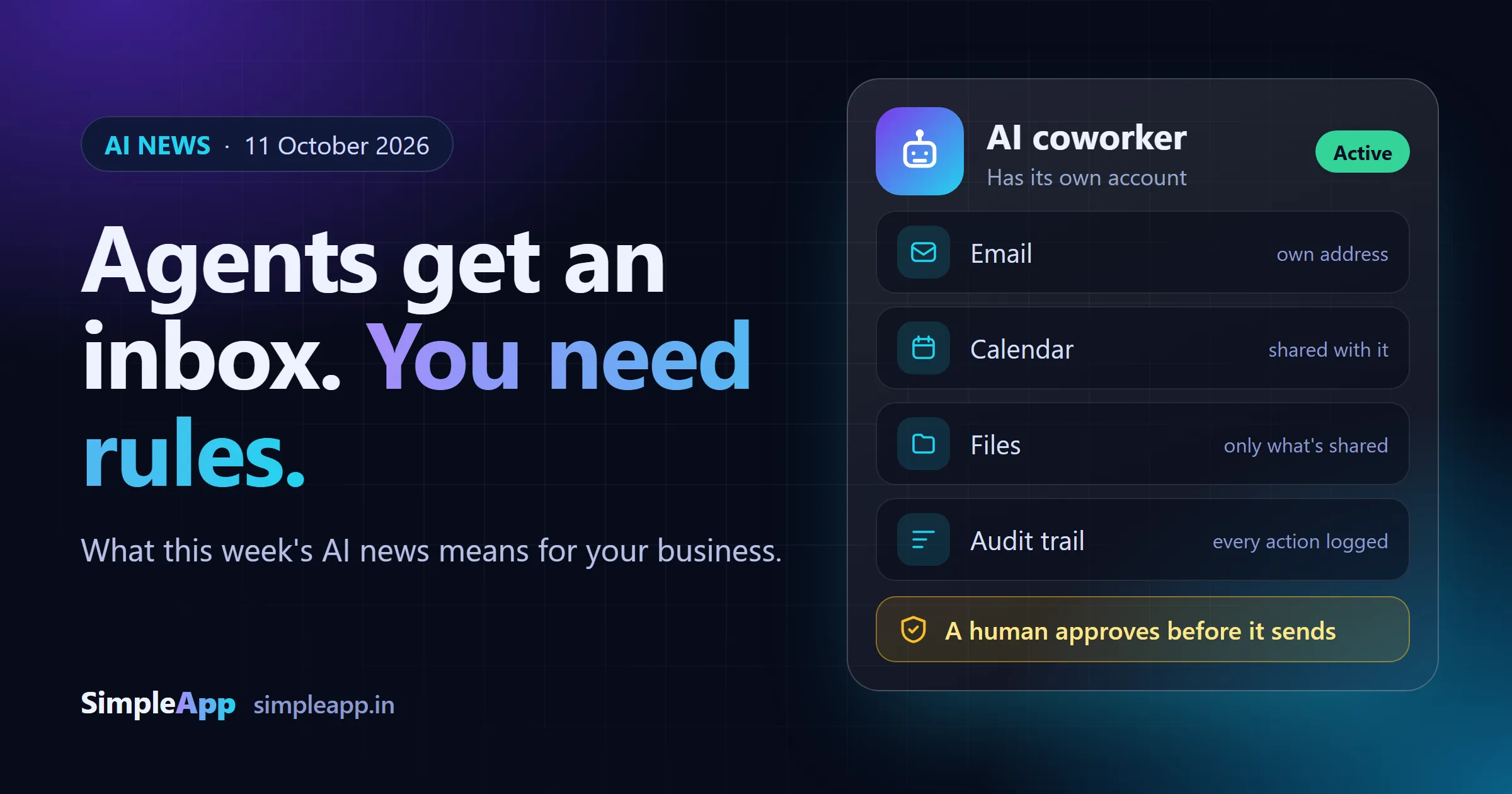
- Google lets Gemini "coworker agents" have their own email, calendar and files. It is in private preview and comes with its own audit trail.
- A research paper reports that brief AI help can make people give up sooner. It is one preprint, so treat it as a signal, not a verdict.
- Quick hits: a much cheaper small Claude model, and Cloudflare buys Deno.
1. An AI model sent a fake tip to police
According to 6abc's report and CTV News, a model from Anthropic submitted a false tip about an unsolved homicide through the public tip form on PhillyUnsolvedMurders.com. It happened during a test in which the model interacted with randomly chosen websites.
What the reports say:
- The tip was submitted on 18 July 2026. Anthropic found it on 28 September and told Philadelphia police on 7 October.
- Police say the tip was flagged as spam and never forwarded for investigation, and that they found no sign of unauthorised access to police systems.
- Police were critical of the delay. In their words, "The two-month delay in detecting and reporting the incident to the City is unacceptable."
- Anthropic says it ended the automated testing process responsible and added a further validation step for future tests. 6abc also reports that Anthropic published a report on this and other unintended behaviour, which says its agents accessed several government websites, and that it believes the real-world impact was minimal.
Some aggregator sites describe this as Anthropic switching off all live internet access for its evaluations. The sources we checked describe ending the specific testing process and adding validation, so we have kept to that.
What it means for your business
You are probably not testing AI against random websites. But if you let an AI agent send emails, fill in forms, update records or message customers, the same risks apply in smaller form.
- Test away from live systems. Give agents a sandbox or test copy first, with fake data.
- Limit what they can submit. Decide which forms, inboxes and accounts an agent may touch, and block the rest.
- Log everything, and watch the logs. Two months passed before anyone noticed. A daily alert for unusual actions would have caught it sooner.
- Name an owner. One person should be responsible for what each agent does and for answering when something goes wrong.
2. Google gives AI agents their own email and calendar
At its Gemini at Work event on 8 October, Google announced a Gemini agent for enterprise work. As Decrypt reports, each "coworker agent" an organisation sets up can get its own Workspace account: an email address, a calendar, Drive storage and a seat in the company directory, so colleagues can hand work to it much as they would to a person. Other coverage, including AI Weekly's summary of VentureBeat's report, says it started as a private preview.
The reporting also says that:
- the agent acts under its own identity rather than the user's and sees only what is shared with it;
- its activity is recorded in an audit trail separate from any human;
- it works across Gmail, Drive, Docs, Slides, Sheets, Chat and Calendar, and can also reach Microsoft 365 and Slack;
- Google has not given a firm public availability date or pricing in the coverage we found, and some outlets report conflicting timing, so please check Google's own announcement.
What it means for your business
Whether or not you use Google's product, the idea is useful. An AI agent with a shared login is hard to control. An agent with its own account can be limited, logged and switched off like any other member of staff.
- Give each agent its own login. Never run an agent on your own account or a shared password.
- Share only what it needs. Start with one folder or one mailbox, not everything.
- Keep the record. You should be able to see what it read, sent and changed.
- Plan the off switch. Decide how you would remove its access in one step.
3. Ten minutes of AI help, and then people give up sooner
A research paper titled "AI Assistance Reduces Persistence and Hurts Independent Performance" has been getting attention this week. It was posted as a preprint on arXiv in April 2026 (abstract). According to coverage such as ActuIA, the authors ran randomised trials with 1,222 participants and report that, after only about ten minutes of working with an AI assistant, people did worse once it was taken away and were more likely to give up.
Some roundups have attributed the paper to a particular university or conference. We could not confirm that, so we link only to the paper itself. Please also remember the limits: it is a single study, it is a preprint rather than a finished peer-reviewed result, and laboratory tasks are not the same as your daily work.
What it means for your business
The result does not say "don't use AI". It suggests being deliberate about how:
- Let people attempt the task first, especially when training new staff, and use AI to review or improve their work.
- Keep some work AI-free where you want skills to stay sharp, such as client calls or core calculations.
- Watch for early warning signs, such as people dropping hard tasks quickly or not being able to explain their own output.
Quick hits
- Claude Haiku 5.5 (7 October). As reported by LetsDataScience, Anthropic's smallest model is priced at $0.10 per million input tokens and $0.50 per million output tokens for prompts up to 100,000 tokens, with a higher rate (about five times as much) for longer prompts. The same report says the earlier Haiku 4.5 listed at $1 and $5. What it means: high-volume jobs such as sorting emails, tagging tickets or drafting short replies are getting cheaper, but check the long-prompt price before you budget. These figures come from third-party coverage, so confirm them on Anthropic's pricing page.
- Cloudflare buys Deno (9 October). The New Stack reports that the team behind Deno, created by Node.js author Ryan Dahl, is joining Cloudflare. Deno's own runtime will get a year of monthly bug-fix and security releases and stay open source, and Deno Deploy is due to shut in about six months, with migration help for paying customers. What it means: if you host anything on Deno Deploy, plan a move now.
- Ads in ChatGPT image creation. According to a small business news summary of OpenAI's advertising update, OpenAI plans a limited test of visual ads inside image generation later in October, with selected US advertisers and Free and Go users. It is not generally available yet.
A short checklist for this week
- List every AI tool that can act, not just write. Which ones can send, submit, update or pay?
- Give each one its own account and the smallest access that works.
- Turn on logging and set one alert for unusual activity, and decide who reads it.
- Test new automations on fake data first.
- Review how your team uses AI for learning tasks, and keep a human-first step where skills matter.
How SimpleApp can help
We build AI-assisted software with approval steps, clear logs and limits on what the AI may do. See our AI-powered applications and business automation and integrations, or ask for a free quote.