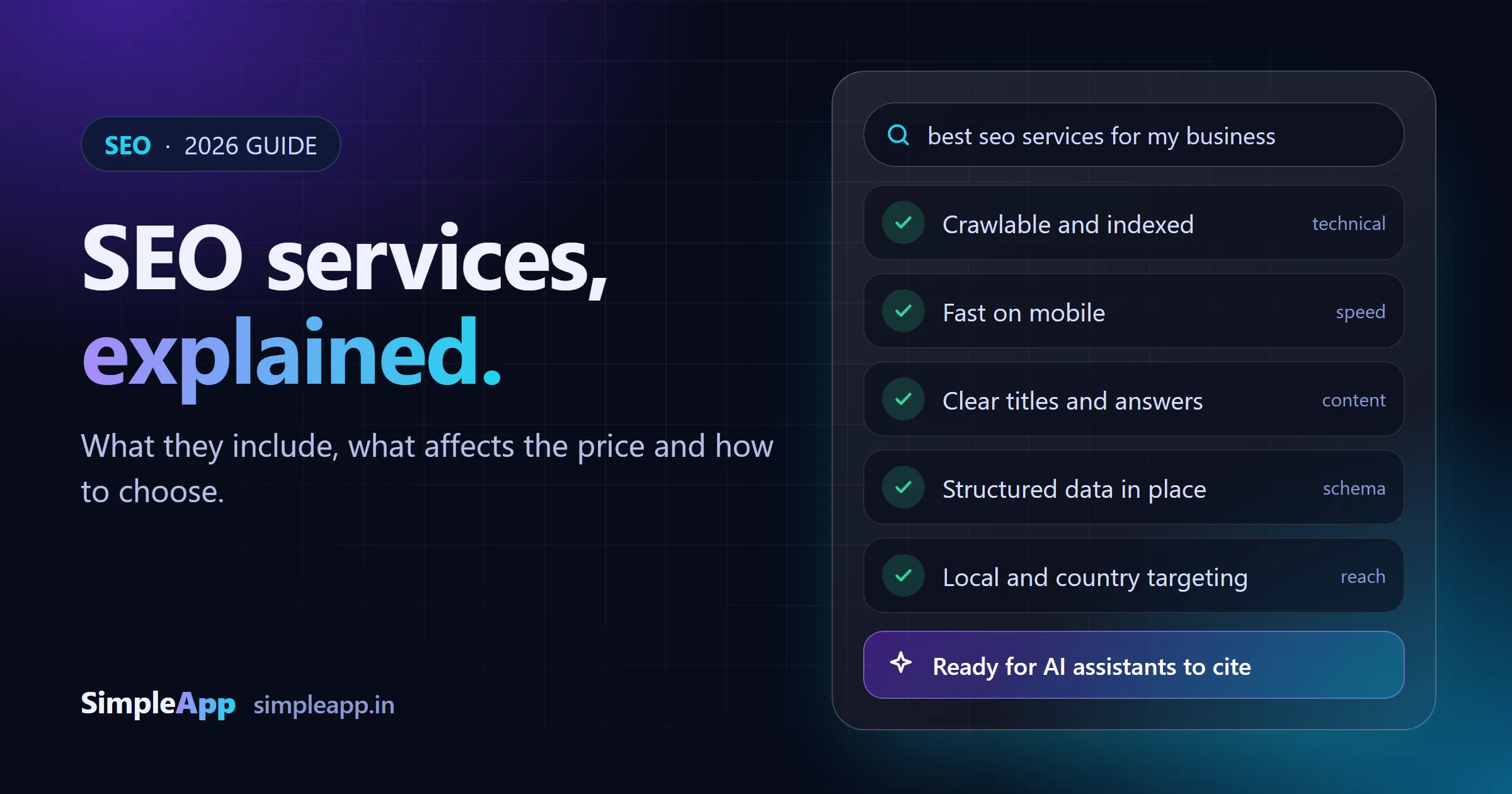
If you are thinking about hiring someone for SEO, you have probably noticed that nobody explains what they will actually do. This guide fixes that. It is written for business owners and managers in any country, in plain language, and it ends with a free two-minute check you can run on your own website.
Last updated: 11 October 2026. SEO changes over time, so treat this as a practical guide and not a rulebook. We are an SEO provider ourselves, so we have tried to be even-handed and to tell you what to watch out for.
The short version
- SEO (search engine optimisation) means making your website easy for search engines to find, understand and trust, so the right people reach it when they search.
- Good SEO services start with a technical audit, then fix site speed, structure, page titles, structured data and tracking, and plan content around what your customers search for.
- Nobody can guarantee rankings. Be careful with promises of "page one in 30 days", bought links and secret methods.
- Results take time. Technical fixes can show within weeks. Growth in traffic usually takes months.
- AI assistants such as ChatGPT, Gemini, Claude and Perplexity favour clear, factual, well-structured pages, so good SEO and AI search readiness overlap heavily.
What are SEO services?
SEO services are the ongoing or one-off work of improving how a website performs in search results, and increasingly in AI-generated answers. A provider looks at what stops search engines from crawling and understanding your pages, what stops visitors from staying, and what your customers are searching for, then fixes and plans around the gaps.
The main types of SEO work
- Technical SEO. Crawling, indexing, site speed, mobile layout, redirects, sitemaps, canonical tags and structured data. It is the foundation, because content cannot rank if search engines cannot reach or understand it.
- On-page SEO. The titles, descriptions, headings, text and internal links of each page, written for both people and search engines.
- Keyword research and content. Finding the words your customers really use, and deciding which pages you need to answer them.
- Local SEO. Google Business Profile, location pages and consistent business details, for businesses that serve a town, city or region.
- E-commerce SEO. Category and product pages, product structured data and the duplicate-content problems that filters and variants create.
- International SEO. Country and language targeting, including hreflang tags, when you serve more than one market.
- Link earning. Getting mentions and links from other reputable sites through useful content, directories and partnerships.
- AI search readiness (also called AEO or GEO). Making pages easy for AI assistants to understand and quote: answer-first writing, FAQ and schema markup, and optionally an llms.txt file.
What a good SEO service should include
- A technical audit with a prioritised list of fixes, not just a long report.
- Fixes carried out, either by the provider or clearly handed to your developer.
- A keyword and page plan for your market and language.
- Search Console and Analytics set up so you can see real numbers.
- Reporting in plain language each month: what changed, what it did and what is next.
- Honest limits. A good provider tells you what they cannot control.
Check your own site: a two-minute SEO health check
Before you hire anyone, find out where you stand. Tick every statement that is true for your website:
If you tick fewer than six, there are probably quick wins waiting. If you tick nine or ten, your foundations are strong and the next gains come from content, links and steady maintenance.
What affects the cost of SEO services?
Prices vary widely between providers and countries, so a single number would mislead you. What changes the price is more useful to know:
- Size and platform of your site. A ten-page business site is much less work than a store with thousands of products.
- Your market. Competitive search terms need more work and take longer than niche ones.
- Starting point. A site with serious technical problems needs more fixing up front.
- Who makes the changes. Providers that only advise cost less than those that also implement.
- How you pay. Common models are a one-off audit, a fixed project, or a monthly plan. Ask for the scope in writing so you can compare like with like.
How long does SEO take?
Technical fixes, such as repairing indexing problems or speeding up pages, can show an effect within a few weeks. Growth in traffic and enquiries usually takes three to six months or more, and longer for new websites or very competitive terms. Anyone who promises faster should explain exactly how.
Red flags, and questions to ask
Red flags
- Guaranteed rankings or "first page in 30 days".
- Secret methods they will not explain.
- Buying links or using link networks, which can get a site penalised.
- Not giving you access to your own accounts and data.
- No written scope, or reports full of jargon and no real numbers.
Questions worth asking
- Who will actually do the work, and how much experience do they have?
- What exactly will I receive each month?
- Will you make the changes yourself, or hand me a list?
- How do you report results, and from which data?
- What have you done for sites like mine, and what could go wrong?
SEO and AI assistants
More people now ask ChatGPT, Gemini, Claude, Perplexity and Copilot instead of, or as well as, searching. Nobody outside those companies can promise that your business will be mentioned. What we can say is that these tools tend to rely on pages that are crawlable, clear, factual and well structured. In practice that means:
- Pages that answer a question in the first sentence or two.
- A real FAQ written in the words customers use.
- Structured data that states who you are and what you offer.
- Fast pages with clean URLs.
- Facts that are consistent everywhere: your name, services, location and contact details.
- Optionally, an llms.txt file, a short plain-text summary of your site. It is a helpful convention, not a guarantee.
This is the same work that helps classic SEO, which is why the two are best handled together.
What you can do yourself this week
- Set up Google Search Console and submit your sitemap.
- Check your top five pages for a unique title, a clear description and one main heading.
- Test your site speed on a phone, and compress oversized images.
- Add a short FAQ to your main service or product page, answering the questions customers really ask.
- Claim and complete your Google Business Profile if you serve local customers.
How SimpleApp can help
Our SEO services are led by a developer with more than ten years of experience on many different websites, and we work remotely with businesses in any country. We make the fixes ourselves: technical SEO, speed, structured data, migrations (see our guide on moving from Shopify to WooCommerce without losing traffic), local and international SEO, and AI search readiness. If your site also needs rebuilding, our web application development team can do that too. Ask for a free estimate.