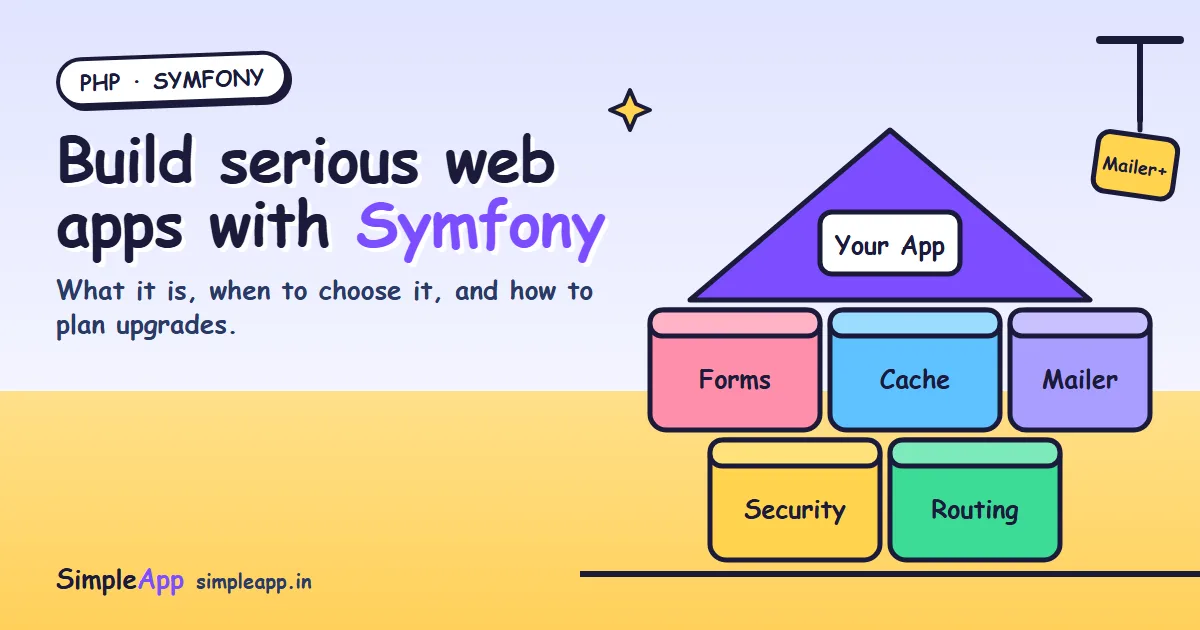
Symfony is one of the most established names in PHP, yet many business owners meet it only when a developer says "we should build this in Symfony". This guide explains what Symfony is, where it shines, which versions matter in 2026, and how it compares with other options such as Drupal, WordPress, Django and Node.js. It also explains how a team that works across several stacks chooses the right one for your project.
Last updated: 22 October 2026. Version and support dates come from the official Symfony release page and can change, so check symfony.com/releases before you plan an upgrade. Comparisons reflect our own project experience and are not benchmarks.
The short version
- Symfony is both a set of reusable PHP packages and a full-stack framework. Its own description names Drupal, PrestaShop and Laravel as examples of applications built on those packages.
- It is a strong fit for custom, long-lived systems: portals, APIs, back-office tools and business platforms that need structure, testing and long-term support.
- Plan around the support calendar. In October 2026, Symfony 7.4 is the long-term-support line, 8.1 is the latest stable release and requires PHP 8.4 or higher, and 8.0 has already reached the end of its maintenance.
- It is not always the right tool. A simple marketing site, a content-heavy editorial site or a data-heavy AI service may be better served by WordPress, Drupal, TYPO3 or Python.
What is Symfony?
Symfony describes itself as a set of PHP packages, a web application framework, a philosophy and a community. That matters, because you can use it in two ways:
- As a framework. You build a complete web application on Symfony's structure: routing, forms, security, caching, mailing, console commands and more.
- As packages. You use individual pieces, such as routing or form handling, inside another project. This is why Symfony's packages turn up inside other products.
The project says its community includes more than 600,000 developers from over 120 countries and more than 3,000 contributors. Those are the project's own figures. The practical meaning is that it is widely used, well documented and easy to hire for.
Why serious projects choose Symfony
Structure that survives growth
Symfony encourages clear separation of concerns, dependency injection and well-defined services. For a small prototype this can feel heavy. For a system that will be maintained for years by several developers, it keeps the code understandable.
A real support calendar
Symfony publishes its release and support dates in advance and offers long-term-support (LTS) versions with years of bug and security fixes. That makes it possible to budget for upgrades instead of being surprised by them.
Built for security and testing
Security, validation, forms and testing tools are part of the ecosystem. That does not make an application secure automatically, but it gives good teams a solid base.
A good fit for APIs and integrations
Symfony is commonly used for APIs, background jobs and integrations with payment, shipping, CRM and ERP systems, and it combines well with a separate front end built in React, Next.js or Vue.
Which Symfony version should you use in 2026?
According to the official release page (checked on 22 October 2026):
| Version | Type | Key dates |
|---|---|---|
| 8.1 | Latest stable | Released May 2026, requires PHP 8.4 or higher, support ends January 2027 |
| 7.4 | LTS | Released November 2025, bug fixes until November 2028, security fixes until November 2029 |
| 6.4 | LTS | Bug fixes end November 2026, security fixes until November 2027 |
| 8.0 | Standard | Reached end of maintenance in 2026 |
| 8.2 | Planned | Planned for November 2026 |
What this means in practice:
- For a new long-term project, 7.4 LTS is the usual safe starting point, with a path to the next LTS later.
- 8.x versions have shorter support windows, so they suit teams that are happy to upgrade often.
- If you are on 6.4 or older, plan the upgrade now. Bug fixes for 6.4 end in November 2026.
- Match PHP and Symfony versions. Symfony 8.x needs PHP 8.4 or higher, so your server must be ready.
Reports on Symfony 8 note that it removed some older configuration formats, so upgrades from 7.x may need configuration changes. Read the official upgrade notes and test on a copy first.
A note on security
Symfony runs on PHP, so PHP itself must be patched too. In October 2026 the PHP project issued emergency fixes for critical remote code execution flaws. Our briefing on the PHP flaw behind the 70% headline explains which versions fix it. Keeping both PHP and Symfony current is part of owning a Symfony application.
When Symfony is not the best choice
A good developer picks the stack for the job. Here is our honest rule of thumb.
| Your project | Often a better fit |
|---|---|
| Brochure site, blog or simple shop | WordPress, with a reviewed set of plugins |
| Large content-driven site with editors, workflows and many languages | Drupal or TYPO3 |
| Small PHP application with a gentle learning curve | CakePHP or a lighter PHP framework |
| Custom portal, API or business platform for the long term | Symfony |
| Interactive front end, dashboards, real-time features | React, Next.js or Vue with an API behind it |
| Data-heavy, automation or AI-oriented back end | Python with Django, Flask or FastAPI |
This table is our own rule of thumb. Every project has exceptions, and the best stack also depends on the team that will maintain it.
One team, many stacks
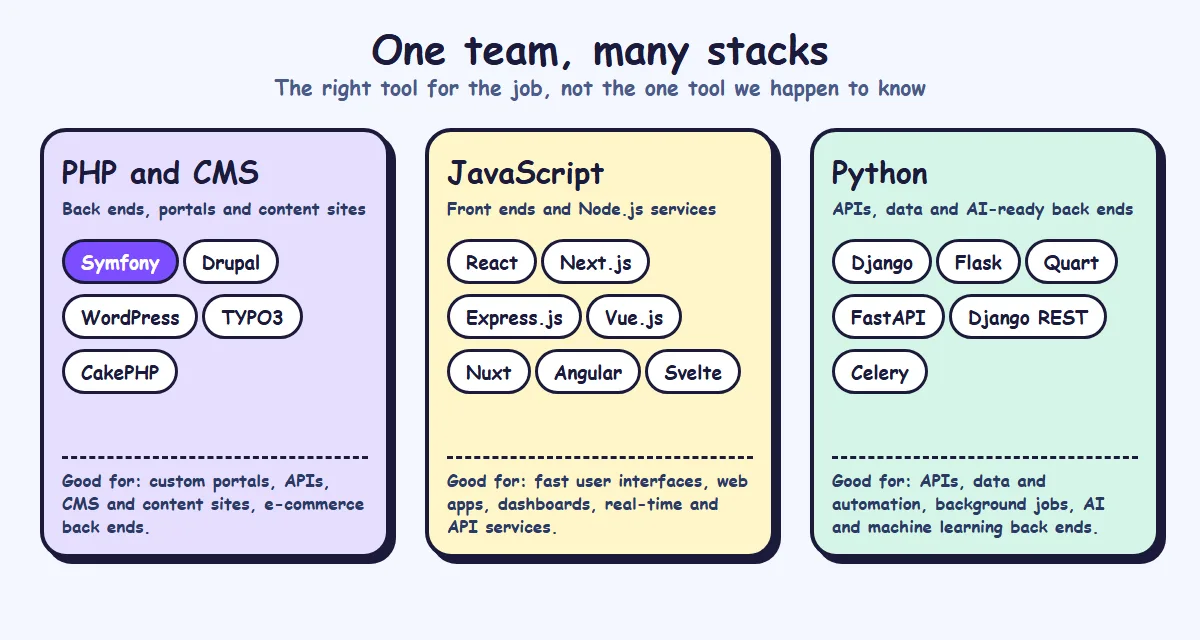
Real projects rarely stay inside one technology. A Symfony back end might serve a Next.js front end, a WordPress marketing site may need an integration with a Python data service, and a Drupal site can need a custom API.
Our team includes experienced developers across the stacks that matter:
- PHP and CMS: Symfony, Drupal, WordPress, TYPO3 and CakePHP.
- JavaScript: React, Next.js and Express.js, along with other well-known front-end frameworks such as Vue.js, Nuxt, Angular and Svelte.
- Python: Django, Flask and Quart, plus related tools such as FastAPI, Django REST Framework and Celery.
Working across stacks has a real benefit for you: we recommend the tool that fits your project, not the one we happen to sell. It also means we can rescue and modernise existing systems, whether the problem is a neglected WordPress site, an old CakePHP application, a Drupal upgrade or a Symfony project that has fallen several versions behind.
What a Symfony project looks like
- Discovery. Understand the business goal, users, integrations and constraints, and decide whether Symfony is the right fit.
- Architecture. Choose the Symfony version, PHP version, database and hosting, and design the main structure, data model and API.
- Build in small steps. Deliver working features in short cycles, with tests and code review.
- Security and quality. Validate input, check permissions on the server, keep secrets out of the code and run automated tests.
- Release. Deploy with a repeatable process, backups and a rollback plan.
- Maintenance. Keep PHP, Symfony and dependencies up to date, watch security advisories and plan upgrades against the support calendar.
What it means for your business
- Do not pick a framework because it is fashionable. Pick it for the project's life: who will maintain it, how long, and how often will it change.
- Ask which version and when support ends. A good developer can tell you this immediately.
- Budget for upgrades. A yearly review of versions is cheaper than an emergency upgrade.
- Keep the front end and back end separate when it helps. A clean API lets you change either side later.
- Own your code. Make sure your contract says you own the source code and can host it where you want.
- Ask about rescue work. If you already have a project in trouble, a multi-stack team can often fix it faster than rewriting it.
A checklist before you start a Symfony project
- What business problem does the application solve, and for whom?
- Is Symfony the right fit, or would WordPress, Drupal, TYPO3 or Python serve better?
- Which Symfony and PHP versions will you use, and when does support end?
- Which systems must it integrate with, such as payments, shipping, CRM or ERP?
- How will you test it, and who reviews the code?
- How will you deploy, back up and roll back?
- Who watches security advisories for PHP and Symfony?
- How will upgrades be planned and paid for?
- Who owns the source code?
How SimpleApp can help
We build custom web applications and APIs, and we maintain and modernise existing systems in Symfony, Drupal, WordPress, TYPO3, CakePHP, React, Next.js, Express.js, Django, Flask and Quart. See our custom software development, web application development and maintenance and support services, look at hiring developers, or ask for a free quote. Our clients own all the source code.